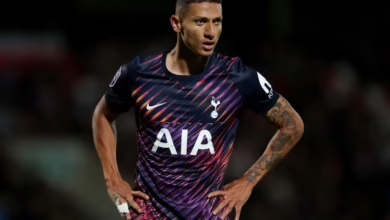
Micky van de Ven has caused media outrage among Tottenham fans with his response when asked about a possible move to Liverpool, Real Madrid or Barcelona

Micky van de Ven has caused media outrage among Tottenham fans with his response when asked about a possible move to Liverpool, Real Madrid or Barcelona.
Tottenham Hotspur defender Micky van de Ven has found himself at the center of a storm after remarks he made in response to questions about potential interest from European giants Liverpool, Real Madrid, and Barcelona. What might have been intended as a candid reflection on the ambitions of a young player has instead been interpreted by many Spurs supporters as a slight against their club, sparking widespread outrage across social media and fan forums.
Rising Star at Spurs
Van de Ven, who joined Tottenham from Wolfsburg in 2023, quickly established himself as one of the Premier League’s most promising defenders. His pace, composure, and ability to recover in defensive transitions earned him praise from pundits and fans alike. Despite injuries that sidelined him for parts of the season, his impact on the team’s defensive solidity has been undeniable.
Tottenham’s supporters had embraced him as a cornerstone of their future, seeing him as a player who could help lead the club back into Champions League contention. That is why his recent comments have cut so deeply.
The Controversial Statement
During a media interview, van de Ven was asked about the possibility of playing for clubs like Liverpool, Real Madrid, or Barcelona. His response was blunt and, to many Spurs fans, disrespectful:
“Tottenham is a great club, but if Liverpool, Real Madrid, or Barcelona come calling, it’s hard to say no. Those are clubs every player dreams of, and honestly, I don’t see myself staying at Spurs forever if that opportunity arises.”
This statement, placed squarely in the middle of the interview, has become the focal point of fan anger. Rather than reaffirming his commitment to Tottenham, van de Ven’s words were seen as an admission that he views the club as a stepping stone rather than a long-term home.
Fan Reaction
The backlash was immediate and fierce. Tottenham fans, already frustrated by inconsistent performances and disappointing results, felt betrayed by van de Ven’s lack of loyalty. Many took to social media to express their anger:
– Disappointment: Supporters voiced their dismay that a player they had invested so much hope in would so casually dismiss the idea of a long-term future at Spurs.
– Frustration: With the team struggling to maintain momentum in the Premier League, fans saw van de Ven’s comments as a distraction and a blow to morale.
– Calls for Action: Some fans even suggested that the club should consider selling him if his commitment is wavering, arguing that Tottenham needs players who are fully invested in the project.
The Broader Context
Tottenham has long faced challenges in retaining top talent. From Gareth Bale’s move to Real Madrid to Harry Kane’s departure to Bayern Munich, the club has often struggled to convince its stars that staying in North London can lead to the same level of success as joining Europe’s elite. Van de Ven’s remarks have reignited fears that Spurs are destined to lose their best players to clubs with greater financial power and trophy-winning pedigree.
The timing of his comments is particularly damaging. Spurs are in the midst of a transitional phase under manager Ange Postecoglou, who has emphasized building a squad capable of competing at the highest level. For a key defender to openly discuss leaving undermines that vision and raises questions about the club’s ability to foster loyalty among its players.
Media and Pundit Analysis
Football analysts have been quick to weigh in on the controversy. Some argue that van de Ven’s comments reflect the reality of modern football, where ambition often drives players toward clubs with greater resources and global prestige. Others, however, believe that he should have shown more respect to Tottenham, especially given the faith the club placed in him by making him a marquee signing.
Former players have also chimed in, with some suggesting that van de Ven’s honesty, while refreshing, was poorly timed and unnecessarily provocative. The consensus among pundits is that while his ambition is understandable, his delivery was clumsy and damaging.
Implications for Tottenham
The fallout from van de Ven’s remarks could have several consequences:
– Transfer Speculation: His comments will inevitably fuel rumors about a potential move in the summer transfer window, particularly if Liverpool or one of the Spanish giants expresses interest.
– Club Stability: Spurs risk further unrest if key players appear unsettled, which could affect team cohesion and performance.
– Fan Relations: Repairing the relationship between van de Ven and the supporters will be a challenge. Without a clear statement of commitment, the distrust may linger.
The Road Ahead
Tottenham now faces a delicate situation. On one hand, van de Ven remains a vital part of their defensive setup and a player with immense potential. On the other, his perceived lack of loyalty has created tension that could undermine the club’s efforts to build a united squad.
The club’s leadership will need to decide whether to publicly back van de Ven and emphasize his importance to the project, or quietly prepare for the possibility of selling him if his commitment cannot be secured. For the fans, the hope is that he will clarify his remarks and reaffirm his dedication to Tottenham, but whether that happens remains to be seen.
Conclusion
Micky van de Ven’s candid response to questions about Liverpool, Real Madrid, and Barcelona has sparked outrage among Tottenham supporters, highlighting the fragile relationship between ambition and loyalty in modern football. While his talent is undeniable, his words have cast doubt on his long-term future at Spurs. The coming months will reveal whether this controversy is a temporary storm or the beginning of a transfer saga that could see yet another Tottenham star depart for Europe’s elite.