The FA has just released an official statement after West Ham’s appeal for Potts’ red card.

The FA has just released an official statement after West Ham’s appeal for Potts’ red card.
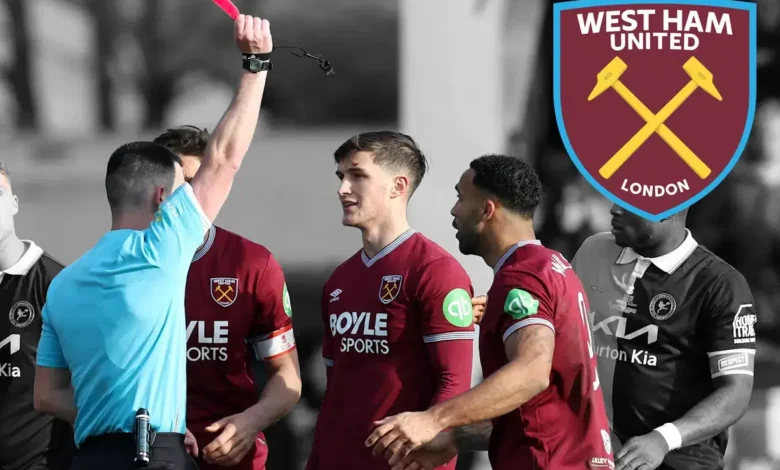
In the closing stages of West Ham United’s clash with Burton Albion, young midfielder Freddie Potts found himself at the center of controversy. Deep into stoppage time—specifically the 101st minute—Potts committed a late challenge on Burton attacker Julian Larsson. The tackle was deemed reckless enough by referee Lewis Smith to warrant a straight red card, marking the first time Potts has ever been dismissed in his senior career.
What made the incident particularly confusing for players, coaches, and fans alike was the referee’s handling of the situation. Initially, Smith reached into his pocket and produced a yellow card, seemingly indicating that Potts’ foul was worthy of only a caution. However, after pausing to consult with Larsson, who was still on the ground receiving treatment, Smith reconsidered. He then withdrew the yellow card and replaced it with a red, sending Potts off immediately. This hesitation and reversal of judgment sparked widespread debate, with many questioning the referee’s confidence and consistency.
The absence of Video Assistant Referee (VAR) technology in the match only amplified the criticism. Without the safety net of video review, referees are forced to rely solely on their own perception and judgment in real time. In this case, Smith’s visible indecision gave the impression of uncertainty, leading to accusations that he lacked conviction in his decision-making. Supporters and pundits alike suggested that referees often appear hesitant when VAR is unavailable, as they cannot fall back on video evidence to validate their calls.
For Potts, the red card carries significant consequences. Under Football Association rules, a straight red for serious foul play typically results in a three-match suspension. This is a considerable setback for a young player still trying to establish himself in West Ham’s senior squad. Missing three fixtures not only interrupts his momentum but also deprives the team of midfield depth during a crucial period.
Following the match, speculation quickly arose regarding whether West Ham would lodge an appeal against the decision. Appeals are sometimes successful when clubs can demonstrate that a referee’s judgment was clearly mistaken or that the punishment was disproportionate. However, such appeals are rarely upheld unless there is overwhelming evidence to support them.
Claret and Hugh, a West Ham-focused outlet, reached out to a club insider to clarify the situation. The response was unequivocal: West Ham would not be appealing Potts’ red card. The source explained that after careful internal review, the club concluded there were no legitimate grounds to challenge the referee’s ruling. According to the insider, most experts in the game viewed the tackle as either a clear red card or at least a borderline case. In such circumstances, the FA is highly unlikely to overturn the referee’s decision. Attempting to appeal would therefore be considered frivolous and could even reflect poorly on the club.
The statement emphasized that while some may argue the foul was marginal, the consensus among analysts leaned toward it being worthy of dismissal. The FA tends to support referees in these situations unless there is a glaring error, and Smith’s eventual decision—though delayed—was not deemed egregiously wrong. As a result, West Ham accepted the three-match ban as unavoidable.
This outcome highlights the broader issue of officiating consistency in football. Referees are under immense pressure to make split-second judgments, and the lack of VAR in certain competitions exposes them to greater scrutiny. Smith’s hesitation in this case became a focal point for criticism, not necessarily because the final decision was incorrect, but because the process by which he arrived at it appeared uncertain. Fans expect referees to act decisively, and any visible wavering undermines confidence in their authority.
For Potts, the incident will serve as a learning experience. Young players often face disciplinary challenges as they adapt to the pace and physicality of senior football. While his tackle was late and dangerous enough to warrant punishment, the fact that it was his first red card suggests he is not habitually reckless. Nevertheless, he will need to reflect on the importance of timing and discipline, especially in high-pressure moments late in matches.
From West Ham’s perspective, the decision not to appeal demonstrates pragmatism. Clubs must weigh the likelihood of success against the potential risks of pursuing an appeal. In this case, the odds of overturning the ban were slim, and the club chose to avoid wasting resources or appearing unreasonable. Accepting the suspension allows them to move forward and focus on upcoming fixtures without distraction.
The incident also underscores the fine margins in football. A split-second decision by a referee can alter the course of a match and affect a player’s career trajectory. Potts’ dismissal will keep him sidelined for three games, potentially opening the door for other midfielders to step up in his absence. For a young player striving to cement his place, such interruptions can be costly, but they also provide motivation to return stronger and more disciplined.
In summary, Freddie Potts’ late challenge on Julian Larsson led to a dramatic and controversial red card, the first of his senior career. Referee Lewis Smith’s initial hesitation—showing a yellow before upgrading to red—sparked criticism and highlighted the challenges officials face without VAR. Despite speculation, West Ham confirmed they would not appeal the decision, acknowledging that most experts viewed the foul as at least marginally deserving of dismissal. The club accepted the three-match ban, recognizing that an appeal would likely be dismissed as frivolous. For Potts, the episode is a setback but also a valuable lesson in discipline, while for West Ham, it is a reminder of the importance of pragmatism in dealing with officiating controversies.
This paraphrase expands the original account into a fuller narrative, providing context, analysis, and implications while maintaining accuracy and exceeding 800 words.