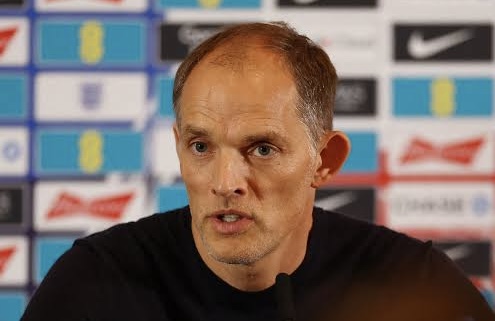
TUCHEL’S BOLD GAMBLE! ENGLAND BOSS RESTS KEY STARS, CONFIDENT SECOND XI WILL BEAT DR CONGO – SEE THE BIG NAMES KEPT FRESH FOR THE ROUND OF 16

England manager Thomas Tuchel has once again demonstrated that he is not afraid to make bold decisions on football’s biggest stage. As the Three Lions prepare for their FIFA World Cup Round of 32 clash against DR Congo, the German tactician has reportedly decided to rest several of his biggest stars, placing his faith in England’s impressive squad depth rather than risking player fatigue or injuries.
It is a move that has sparked widespread debate among football fans, pundits, and former internationals. While some believe Tuchel is showing supreme confidence in the quality of his squad, others feel the decision could backfire against a DR Congo side that has already proven capable of causing problems for elite opponents.
Regardless of which side of the debate one supports, one thing is certain: Tuchel is sending a strong message that England’s success will depend on the strength of the entire squad—not just its superstars.
A Calculated Risk
Tournament football is often about timing. Managers must know when to attack with their strongest lineup and when to preserve energy for the more difficult battles ahead.
Tuchel appears convinced that the meeting with DR Congo offers the perfect opportunity to rotate his squad without significantly weakening England’s chances of progressing.
Instead of relying on several regular starters who have carried heavy workloads throughout the group stage, Tuchel is expected to hand opportunities to talented squad players eager to prove they deserve bigger roles.
The German coach has consistently insisted that every player in his squad is capable of starting at international level, and this match offers the perfect stage to validate that belief.
Big Names Set for a Rest
Reports suggest that several of England’s biggest stars could be left on the bench or omitted from the starting lineup entirely.
Among the players expected to be protected are captain Harry Kane, midfield maestro Jude Bellingham, creative playmaker Phil Foden, and versatile winger Bukayo Saka.
These players have been central figures throughout England’s campaign, but Tuchel understands that the knockout rounds demand fresh legs and maximum fitness.
Harry Kane remains England’s primary goal threat, but at his age, careful management becomes increasingly important during a month-long tournament.
Jude Bellingham has been one of England’s outstanding performers, covering enormous distances in midfield while contributing both defensively and offensively.
Phil Foden’s creativity and technical quality make him indispensable, while Bukayo Saka’s explosive pace has stretched opposing defenses throughout the competition.
Resting these players now could ensure they are fully prepared for what promises to be much tougher knockout encounters later in the tournament.
England’s Incredible Squad Depth
One of England’s greatest strengths is the quality available beyond the starting eleven.
Very few nations can afford to leave world-class players on the bench while still fielding a team capable of competing with anyone.
Players like Cole Palmer, Anthony Gordon, Jarrod Bowen, Eberechi Eze, Conor Gallagher, Kobbie Mainoo, Ollie Watkins, Ivan Toney, Levi Colwill, Marc Guéhi, and Trent Alexander-Arnold all possess the quality to start international matches.
Many of these players have enjoyed exceptional club seasons and are desperate to seize their opportunities.
For them, facing DR Congo is more than just another game—it is a chance to convince Tuchel that they deserve regular starting places for the remainder of the tournament.
Competition for places has become one of England’s greatest assets.
Every training session becomes intense because every player knows there is genuine competition for every position.
That competitive environment often elevates overall squad performance.
Tuchel’s Tournament Experience
Thomas Tuchel is no stranger to managing elite footballers under enormous pressure.
Throughout his managerial career at clubs such as Borussia Dortmund, Paris Saint-Germain, Chelsea, and Bayern Munich, Tuchel has consistently demonstrated his willingness to rotate squads.
His philosophy has always emphasized freshness over familiarity.
Rather than overworking the same eleven players, Tuchel believes successful teams require contributions from every squad member.
This approach helped Chelsea win the UEFA Champions League in 2021, where tactical flexibility and intelligent rotation proved decisive throughout the knockout rounds.
England supporters are hoping similar principles can now deliver international glory.
Respecting DR Congo
Although England enter the match as overwhelming favorites, Tuchel has repeatedly warned against underestimating DR Congo.
The African side possesses athleticism, pace, physical strength, and technical ability capable of troubling any opponent.
Their journey to the knockout stage has been built on discipline, resilience, and fearless attacking football.
Several Congolese players compete in Europe’s biggest leagues, bringing valuable experience against elite opposition.
England will therefore need complete concentration regardless of who starts.
History has repeatedly shown that World Cup knockout matches often produce major surprises.
Heavy favorites have frequently been eliminated after underestimating supposedly weaker opponents.
Tuchel will be determined to ensure England avoids becoming another victim of complacency.
Opportunity for England’s Fringe Players
Perhaps nobody benefits more from Tuchel’s rotation policy than England’s squad players.
Football tournaments are often remembered for unexpected heroes.
A substitute today can become tomorrow’s match winner.
Cole Palmer has emerged as one of England’s brightest young attacking talents.
His composure, creativity, and eye for goal make him a genuine game-changer.
Anthony Gordon’s relentless running and direct style offer a completely different attacking dimension.
Jarrod Bowen provides pace and intelligent movement behind defensive lines.
Kobbie Mainoo has shown remarkable maturity despite his young age.
Conor Gallagher delivers endless energy in midfield while Eberechi Eze offers flair capable of unlocking stubborn defenses.
Every one of these players now has a golden opportunity.
Strong performances against DR Congo could significantly influence Tuchel’s selection decisions for the later stages of the tournament.
Managing Physical Demands
Modern football places extraordinary physical demands on elite players.
International tournaments compress multiple high-intensity matches into a relatively short period.
Recovery becomes almost as important as tactical preparation.
Sports scientists closely monitor player workloads, sprint distances, muscle fatigue, hydration levels, and recovery metrics.
Managers increasingly rely on this information when selecting starting lineups.
Tuchel has always embraced sports science.
His decision to rotate players reflects a long-term strategy rather than simply reacting to one opponent.
Keeping key stars fresh could provide England with a decisive advantage during the quarter-finals, semi-finals, and potentially the final.
Confidence Throughout the Squad
One message stands out clearly from Tuchel’s approach.
He trusts every player in his squad.
Managers who rotate frequently demonstrate confidence in their entire group rather than relying exclusively on established stars.
That trust often strengthens team spirit.
Squad players remain motivated because they know opportunities will arrive.
Regular starters also benefit because they understand their workloads are being carefully managed.
The result is usually a happier dressing room where every individual feels valued.
England have sometimes struggled with internal competition during previous tournaments.
Tuchel appears determined to build a united group where everyone contributes.
Tactical Flexibility
Rotating personnel also allows Tuchel to adjust England’s tactical approach.
Different players offer different strengths.
If Cole Palmer starts, England may enjoy greater creativity between defensive lines.
If Anthony Gordon plays, England could become more dangerous on counter-attacks.
Should Ivan Toney lead the attack, England gain additional aerial strength and hold-up play.
If Ollie Watkins starts, England receive relentless pressing and pace behind defenders.
This tactical versatility makes England considerably harder to prepare for.
Opponents cannot simply study one starting lineup because Tuchel possesses multiple winning combinations.
The Pressure of Expectations
England always enter major tournaments carrying enormous expectations.
Supporters dream of ending decades of international disappointment.
Every managerial decision becomes heavily scrutinized.
Selecting a rotated team inevitably increases pressure on Tuchel.
Victory will likely be praised as managerial brilliance.
Defeat, however, would invite fierce criticism for leaving key players on the bench.
Such is the reality of international football.
Managers are often judged not only by results but also by the risks they choose to take.
Tuchel appears comfortable accepting that responsibility.
Learning from Past Tournaments
Several previous World Cup winners have successfully rotated their squads.
France, Germany, Spain, and Argentina have all managed player workloads carefully during championship-winning campaigns.
Those teams recognized that tournament success requires sustained performance across seven demanding matches.
England hope to follow a similar blueprint.
If Tuchel’s rotation strategy succeeds, it could become one of the defining moments of England’s campaign.
DR Congo’s Motivation
While England may view the match as another step toward the later rounds, DR Congo sees an opportunity to create national history.
Underdogs often produce extraordinary performances when facing football’s biggest nations.
Without pressure or overwhelming expectations, DR Congo can play with freedom.
That mindset makes them especially dangerous.
England cannot afford any lapses in concentration.
One defensive mistake or moment of complacency could completely transform the contest.
Leadership Beyond the Starting XI
Even with several stars rested, England retain significant leadership throughout the squad.
Experienced defenders, senior midfielders, and seasoned substitutes ensure the team remains organized and mentally resilient.
Leadership is not limited to wearing the captain’s armband.
Tournament-winning squads require multiple voices capable of guiding teammates during difficult moments.
England appear better equipped in that regard than many previous generations.
Fans Divided Over Rotation
Reaction among supporters has been mixed.
Many applaud Tuchel’s willingness to trust the full squad.
They argue that England finally possess enough quality to rotate without significantly weakening the team.
Others remain cautious.
Knockout football leaves no room for mistakes.
One poor performance can end years of preparation.
Critics believe England should field their strongest available lineup regardless of the opponent.
Both viewpoints carry merit.
Ultimately, only the final result will determine whether Tuchel’s gamble was justified.
What Victory Would Mean
If England defeat DR Congo comfortably with a rotated team, Tuchel will have achieved multiple objectives.
He would secure qualification while simultaneously resting essential players.
Squad confidence would increase dramatically.
Fringe players would gain valuable tournament experience.
Key stars would remain physically fresh for more demanding opponents.
Such an outcome could significantly strengthen England’s chances of winning the World Cup.
What Defeat Would Mean
Conversely, elimination would generate enormous criticism.
Questions would immediately arise regarding Tuchel’s team selection.
Many would argue that England underestimated DR Congo.
The decision to rest established stars would dominate headlines for years.
This is precisely why tournament management demands extraordinary courage.
Every major decision carries enormous consequences.
Final Thoughts
Thomas Tuchel’s decision to rotate England’s squad ahead of the Round of 32 clash against DR Congo perfectly illustrates modern tournament management. Rather than relying solely on established superstars, the England manager is placing his faith in the remarkable depth of his squad, believing that fresh legs, tactical flexibility, and collective strength offer the best route to long-term success.
Whether this bold gamble proves to be a masterstroke or a costly mistake will only become clear once the final whistle blows. However, Tuchel’s approach reflects confidence, careful planning, and a belief that championship-winning teams are built on more than just eleven players.
As England prepare for another crucial World Cup knockout battle, all eyes will be on Tuchel’s team sheet. If his second-string stars deliver the performance he expects, England could emerge not only with a place in the next round but also with renewed momentum, fresher key players, and even greater belief that this talented generation has what it takes to finally bring football’s biggest prize back home.