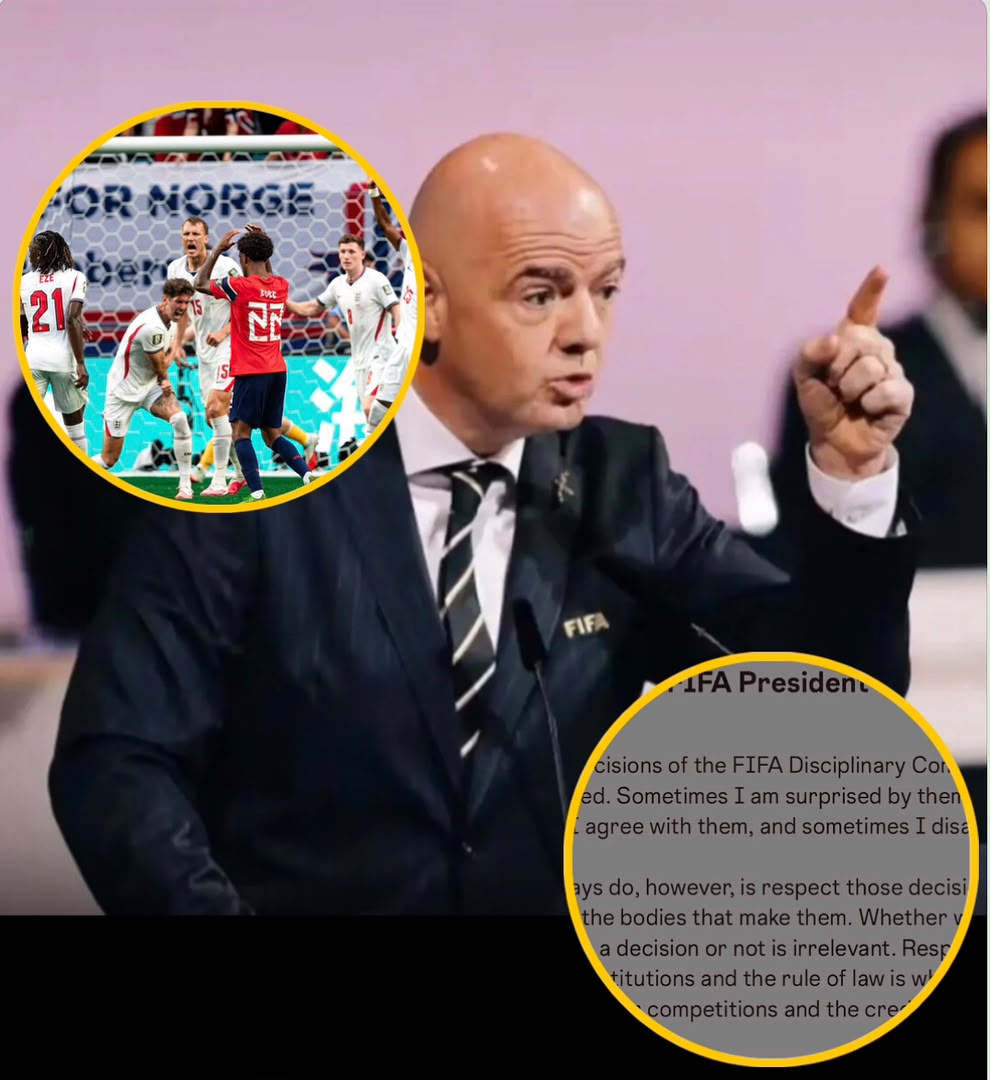

FIFA’s Statement on England’s Controversial Goal:
England’s dramatic quarterfinal victory over Norway at the 2026 FIFA World Cup has been overshadowed by a freak incident that forced FIFA to issue an official statement. The controversy centers on Jude Bellingham’s equalizing goal, which some claim should have been disallowed after the ball appeared to strike an overhead camera wire. The incident was not captured clearly by TV cameras, sparking outrage, confusion, and heated debate across the footballing world.
The Incident That Sparked Chaos
In the dying moments of the first half, Norway goalkeeper Ørjan Nyland launched a goal kick high into the Atlanta night sky. As the ball traveled, spectators and players alike noticed a sudden, unnatural dip in its trajectory. Many believed it had brushed against one of the overhead camera wires suspended above the pitch.
England quickly regained possession, and Jude Bellingham slotted home a precise finish to level the score at 1–1. The goal proved pivotal, as England went on to win 2–1 in extra time, securing their place in the semifinals.
But the controversy erupted instantly. Norway’s players surrounded referee Clement Turpin, arguing that the ball had clearly touched the wire. By the laws of the game, if the ball strikes any overhead equipment, play must be stopped and restarted with a dropped ball.
Why FIFA Was Forced to Respond
The uproar was amplified by the fact that TV cameras failed to capture the moment of contact. Fans watching around the world saw only the ball’s unusual flight path, fueling speculation and conspiracy theories.
With social media ablaze and pundits questioning the integrity of the officiating, FIFA had no choice but to issue a statement. The governing body explained that Connected Ball sensor technology—a system embedded in every match ball—detected no irregular contact.
According to FIFA, the ball’s internal sensors track every micro-touch, registering a “heartbeat” of data. In this case, there was no spike indicating contact with the wire. Therefore, officials concluded that the ball had not touched the overhead equipment, and the goal stood.
Norway’s Furious Reaction
Norway’s players and coaching staff were livid. Erling Haaland, visibly frustrated, confronted the referee at halftime. Coach Ståle Solbakken demanded clarification, insisting that the ball’s sudden dip was proof of interference.
Goalkeeper Nyland was seen slapping the turf in anger after conceding, convinced that the trajectory had been altered. Norwegian fans echoed these sentiments, accusing FIFA of protecting England and questioning whether technology had failed in a critical moment.
England’s Perspective
For England, the incident was seen as a stroke of fortune. While the controversy raged, players like Declan Rice emphasized the importance of focusing on the match rather than external noise. Rice, who has been a linchpin in England’s midfield, noted that the team had to remain composed and capitalize on the momentum provided by Bellingham’s goal.
England’s camp largely avoided commenting on the specifics of the incident, preferring to highlight their resilience and determination in overcoming Norway’s early lead.
Technology vs Human Perception
This incident highlights a growing tension in modern football: the reliance on technology versus the instincts of players and fans.
– Connected Ball technology is designed to remove doubt, offering precise data that human eyes might miss.
– Yet, when visual evidence is lacking—as in this case—fans often trust their perception over unseen sensors.
– The absence of clear TV footage created a vacuum that conspiracy theories quickly filled.
This raises questions about transparency. Should FIFA release sensor data publicly after such incidents? Would that help restore trust, or would it simply fuel further debate?
Football history is littered with controversial goals:
– 1966 World Cup Final: Geoff Hurst’s “did it cross the line?” goal against West Germany remains debated to this day.
– 2010 World Cup: Frank Lampard’s disallowed goal against Germany, where the ball clearly crossed the line, led to the introduction of goal-line technology.
– Euro 2004: A similar incident occurred when a ball struck overhead equipment, leading to confusion and stoppage.
The England-Norway controversy now joins this list, reminding fans that even with advanced technology, football remains vulnerable to freak occurrences.
The Laws of the Game
According to the IFAB Laws of the Game:
– If the ball touches a match official, goal frame, or overhead equipment (such as camera wires), play must be stopped.
– The referee should restart with a dropped ball at the point of contact.
In this case, FIFA insists the ball did not touch the wire, meaning the referee was correct to allow play to continue.
The Broader Implications
The controversy has implications beyond one match:
– Tournament Integrity: FIFA must protect the credibility of officiating, especially at the World Cup’s knockout stages.
– Technology Trust: Fans must decide whether to trust sensor data over their own eyes.
– Future Protocols: FIFA may need to improve transparency, perhaps by showing sensor data in real time or ensuring overhead incidents are always captured by cameras.
Media and Fan Reactions
The media frenzy has been relentless. Headlines across Europe and beyond questioned whether England had been unfairly favored. Social media hashtags like #WireGate and #EnglandGoal trended globally.
Fans split into camps:
– Some argued that FIFA’s reliance on technology was justified.
– Others claimed the lack of visual evidence undermined the decision.
This polarization reflects a broader debate about football’s future: should technology dominate, or should human judgment remain central?
Despite the controversy, England must now focus on their semifinal clash. The incident may serve as motivation, galvanizing the squad to prove they deserve their place. Players like Rice, Bellingham, and Harry Kane will be crucial in ensuring the team remains mentally strong.
Southgate, known for his calm demeanor, will likely remind his players that external noise cannot dictate their performance. England’s ability to rise above the controversy could define their campaign.
The freak incident during England’s quarterfinal victory over Norway has forced FIFA into the spotlight. By relying on Connected Ball technology, FIFA insists the goal was legitimate, despite widespread skepticism.
This controversy underscores the delicate balance between technology and perception in modern football. While FIFA’s statement may settle the matter officially, fans and pundits will debate it for years to come.
For England, the goal stands, and their journey continues. For Norway, it is a bitter pill to swallow. And for football, it is another reminder that even in the age of advanced technology, the beautiful game remains gloriously unpredictable.