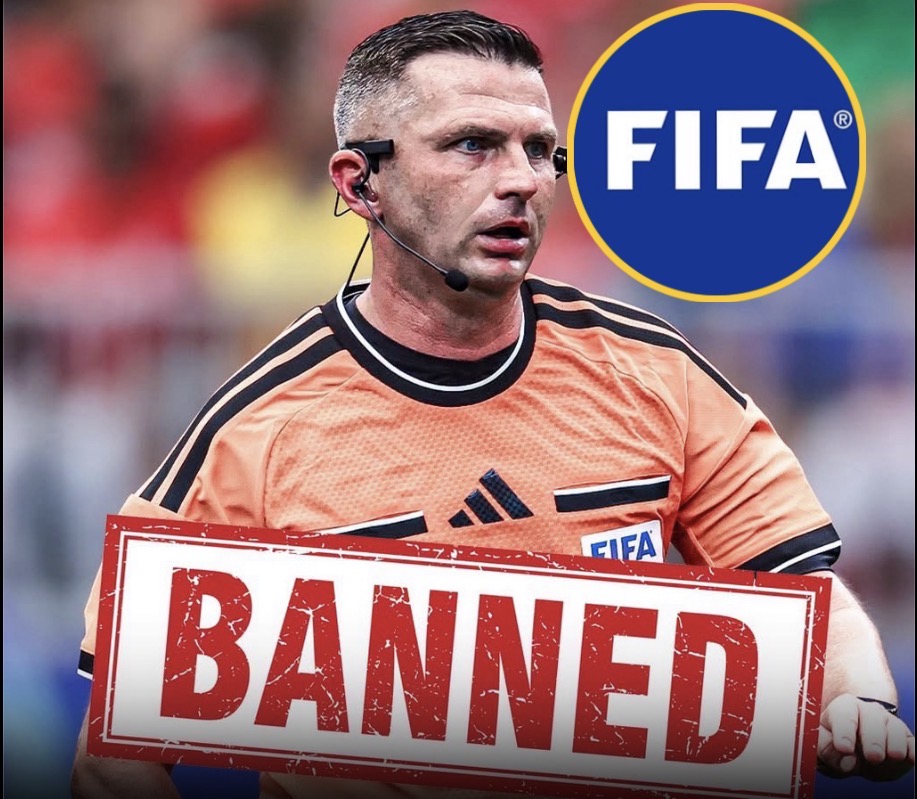
MICHAEL OLIVER BANNED FROM REFEREEING WORLD CUP FINAL IF ONE OF TWO NATIONS REACHES SHOWPIECE CLASH

The road to the FIFA World Cup final is filled with drama, tension, and unforgettable moments, but not all of the biggest stories involve the players on the pitch. Sometimes, the spotlight falls on the officials responsible for enforcing the rules of the game. That is exactly what has happened with English referee Michael Oliver, whose potential involvement in the World Cup final has become a major talking point as the tournament reaches its decisive stages.
Reports and discussions surrounding FIFA’s referee appointment process have raised an important question: could Michael Oliver be prevented from officiating the World Cup final if certain nations qualify? The answer lies in FIFA’s long-standing policies regarding neutrality and the appointment of match officials for major international fixtures.
As the competition intensifies and only a handful of teams remain in contention for football’s biggest prize, speculation has grown regarding which referees could be entrusted with the responsibility of handling the final. Michael Oliver is widely regarded as one of the world’s leading officials, yet circumstances beyond his control could potentially rule him out of the tournament’s most prestigious assignment.
Michael Oliver’s Rise to the Top
Over the past decade, Michael Oliver has established himself as one of the most respected referees in international football. The English official has overseen numerous high-profile matches in the Premier League, UEFA Champions League, European Championship competitions, and FIFA tournaments.
Known for his calm demeanor, fitness, communication skills, and willingness to make difficult decisions under pressure, Oliver has earned praise from players, managers, and fellow officials alike.
Refereeing at the highest level requires exceptional concentration, consistency, and courage. Every decision is scrutinized by millions of viewers, while technology such as VAR ensures that controversial moments are replayed repeatedly from multiple angles.
Despite these pressures, Oliver has maintained a reputation as one of the game’s elite referees.
That reputation naturally makes him a strong candidate for appointment to the latter stages of any major tournament.
FIFA’s Neutrality Principle
The key issue surrounding Oliver’s eligibility for the World Cup final is FIFA’s commitment to neutrality.
For decades, FIFA has followed the principle that referees should not officiate matches involving their own national teams.
This policy is designed to eliminate any perception of bias and preserve the integrity of the competition.
Even if a referee is universally respected and completely impartial, FIFA generally avoids situations where questions about nationality could overshadow the match itself.
As a result, officials are normally excluded from matches involving their home country.
In Michael Oliver’s case, that means he cannot referee any match involving England.
This is standard practice and applies to referees from all participating nations.
Why the Final Could Be Different
The discussion becomes more complicated when considering the World Cup final.
Unlike earlier rounds, FIFA’s options become increasingly limited as the tournament progresses.
The governing body must select a referee who has performed consistently throughout the competition while also ensuring that there is no conflict of interest.
If England were to reach the World Cup final, Michael Oliver would automatically be unavailable for appointment.
No matter how impressive his performances had been during the tournament, FIFA would not assign an English referee to officiate England’s most important match.
This aspect is straightforward and widely understood.
However, there are situations involving other nations that could also influence FIFA’s decision-making process.
The Challenge of Perceived Conflicts
Modern football operates in an environment where perception matters almost as much as reality.
FIFA understands that every major appointment will be analyzed extensively by supporters, journalists, and football experts.
As a result, the governing body often seeks to avoid not only actual conflicts of interest but also situations that could create unnecessary controversy.
For example, if a referee has frequently officiated matches involving a particular nation, league, or group of players, FIFA may consider whether such connections could become a distraction.
The objective is to ensure that the final is remembered for the football rather than debates surrounding the referee’s appointment.
Because of this, FIFA carefully reviews numerous factors before making its selections.
England’s Progress Creates Discussion
England’s advancement deep into the tournament has inevitably brought Michael Oliver’s name into the conversation.
As one of the world’s most experienced referees, he would ordinarily be among the candidates for a World Cup final appointment.
Yet England’s presence in the latter stages significantly complicates matters.
If the Three Lions continue progressing toward the final, Oliver’s chances of receiving the assignment diminish accordingly.
This is not a reflection of his quality or performance.
Instead, it is simply the consequence of FIFA’s neutrality rules.
Many observers believe Oliver possesses the credentials required to officiate the biggest match in world football.
Unfortunately for him, nationality remains a decisive factor.
The Importance of Referee Selection
Selecting a World Cup final referee is one of FIFA’s most significant responsibilities.
The final represents the pinnacle of international football, watched by billions of people around the globe.
Every decision made during the match carries enormous weight.
A penalty award, red card, offside call, or VAR intervention can potentially determine the outcome of the tournament.
For this reason, FIFA places enormous emphasis on referee appointments.
Officials are evaluated throughout the competition based on numerous criteria, including:
* Accuracy of decisions.
* Positioning and movement.
* Communication with players.
* Control of matches.
* Consistency.
* Use of VAR protocols.
* Fitness levels.
Only those who perform exceptionally well remain in contention for the final.
Previous Examples
The situation facing Michael Oliver is not unique.
Throughout World Cup history, many highly respected referees have been prevented from officiating certain matches due to nationality restrictions.
FIFA’s commitment to neutrality has consistently taken precedence over individual achievement.
Even referees considered among the best in the world have sometimes seen their opportunities limited because their national teams advanced deep into tournaments.
This approach has helped maintain confidence in the fairness of FIFA’s competitions.
While some supporters may disagree with specific appointments, the principle of neutrality remains widely accepted.
Pressure on Modern Referees
The debate surrounding Oliver also highlights the immense pressure faced by referees in contemporary football.
Officials operate in an environment unlike anything previous generations experienced.
Every decision is captured by dozens of cameras.
VAR reviews incidents in extraordinary detail.
Social media reactions can spread globally within seconds.
A single controversial decision may dominate headlines for days.
Consequently, referees are under constant scrutiny.
Despite these challenges, top officials continue striving to perform at the highest possible standard.
Michael Oliver’s consistent presence in elite competitions demonstrates the level of trust placed in him by football authorities.
What Happens Next?
As the tournament approaches its conclusion, FIFA’s referee committee will continue monitoring performances closely.
Appointments for the semi-finals and final are typically announced only after extensive evaluation.
The committee considers numerous factors before reaching a decision.
These include:
* Tournament performances.
* Match difficulty.
* Referee fitness.
* Neutrality requirements.
* VAR experience.
* Overall consistency.
Should England reach the final, Oliver’s exclusion would be automatic.
If England are eliminated before the final, his chances would increase significantly, provided FIFA believes he has been among the competition’s strongest performers.
Ultimately, the decision rests entirely with FIFA.
A Reflection of FIFA’s Commitment to Fairness
While some fans may view nationality restrictions as frustrating for elite referees, the policy serves an important purpose.
Football’s governing body must ensure that the integrity of its competitions remains beyond question.
The World Cup final is too important to allow even the slightest perception of favoritism or conflict of interest.
By enforcing strict neutrality standards, FIFA aims to protect both the competition and the officials themselves.
Referees can focus on their performances without facing accusations linked to their nationality.
In that sense, the rules benefit everyone involved.
Conclusion
Michael Oliver remains one of the finest referees in world football and a strong candidate for major appointments at every international tournament. However, FIFA’s commitment to neutrality means that his dream of officiating a World Cup final could depend heavily on which nations reach the tournament’s showpiece match.
If England are among the finalists, Oliver would be automatically ruled out due to standard FIFA regulations preventing officials from refereeing matches involving their own country. Even beyond England’s participation, FIFA will continue examining every possible conflict of interest before selecting the referee for football’s biggest occasion.
As the World Cup enters its final stages, attention will remain focused not only on the teams competing for glory but also on the officials entrusted with maintaining fairness on the sport’s grandest stage. Whether Michael Oliver ultimately receives the appointment or not, his reputation as one of the world’s leading referees remains firmly intact, and his performances throughout the tournament will continue to be closely watched by football fans across the globe.