Steve Clarke sends Scotland fans into meltdown with an emotional 72-word Instagram message to the Tartan Army

Steve Clarke sends Scotland fans into meltdown with an emotional 72-word Instagram message to the Tartan Army.
Scotland’s long-awaited return to the FIFA World Cup has ended in bitter disappointment, with Steve Clarke’s side facing an agonizing exit after a campaign that began with optimism but quickly unraveled against elite opposition. After waiting nearly three decades to grace football’s biggest stage once again, the Tartan Army crossed the Atlantic in remarkable numbers, believing this generation of Scottish players could finally erase years of World Cup frustration.
Instead, the campaign has become another painful chapter in Scotland’s football history. A hard-fought opening victory over Haiti briefly raised hopes of a historic qualification for the knockout rounds, but consecutive defeats to Morocco and Brazil have left Clarke’s men staring at elimination. Although there remains a mathematical possibility of advancing as one of the tournament’s best third-placed teams, the chances appear increasingly remote, leaving players and supporters reflecting on what might have been.
The emotional weight of Scotland’s return cannot be understated. It represented the nation’s first appearance at the World Cup in 28 years, a milestone that many supporters feared they might never witness again. Qualification had been celebrated across Scotland as one of the country’s greatest modern football achievements, with expectations soaring as the tournament approached.
The Tartan Army embraced the occasion with its trademark passion, filling stadiums across North America with a sea of blue shirts, tartan scarves, and unforgettable chants. From Boston to Atlanta and Miami, Scotland’s supporters transformed every venue into a home away from home, earning praise from neutral fans for their unwavering loyalty and infectious spirit.
Scotland’s campaign began in encouraging fashion against Haiti in Boston on June 13. Clarke’s side looked composed, disciplined, and determined to seize the opportunity presented by the tournament opener. The breakthrough eventually came through Lawrence Shankland, whose clinical finish proved enough to secure a crucial 1-0 victory.
Although the performance was not spectacular, it demonstrated the resilience that had become a hallmark of Clarke’s Scotland. Defensively organized and willing to battle for every ball, the team managed the contest effectively and collected three priceless points. The result sparked celebrations among Scottish supporters and fueled belief that a place in the Round of 32 was genuinely within reach.
The victory also eased pressure on the squad ahead of a far more demanding challenge against Morocco. Confidence within the camp appeared high, with players speaking openly about building momentum and writing a new chapter in Scottish football history.
However, that optimism would soon be tested.
Morocco arrived in Atlanta carrying the confidence of one of international football’s strongest recent performers. Their technical quality, tactical discipline, and composure on the ball quickly became evident as they controlled large portions of possession.
Despite Scotland’s determined defensive display, Morocco gradually imposed themselves on the match. Hakim Ziyech orchestrated attacks with intelligence and precision, repeatedly finding dangerous spaces between Scotland’s midfield and defensive lines. Eventually, the pressure paid off when Youssef En-Nesyri found the decisive breakthrough, giving Morocco a narrow but deserved 1-0 victory.
For Scotland, the defeat was frustrating rather than humiliating. They remained competitive throughout the contest and created several promising moments but lacked the cutting edge required to punish a disciplined Moroccan side. The result meant everything would come down to the final group match against five-time world champions Brazil.
Few expected Scotland to dominate Brazil, but supporters hoped for a courageous performance capable of producing one of the greatest upsets in World Cup history. Instead, Brazil demonstrated precisely why they remain among football’s global powerhouses.
From the opening whistle in Miami, Brazil controlled the rhythm of the game with breathtaking speed and technical excellence. Vinícius Júnior repeatedly stretched Scotland’s defense with his explosive pace and direct running, creating problems that Clarke’s side struggled to contain.
The Brazilian winger eventually scored twice during an outstanding individual display, while Matheus Cunha added another goal as Brazil secured a convincing 3-0 victory. Scotland fought bravely but ultimately found themselves overwhelmed by the quality, movement, and clinical finishing of their illustrious opponents.
As the final whistle sounded, Scottish players collapsed to the turf in visible disappointment while thousands of travelling supporters remained in the stands, applauding their team despite another heartbreaking World Cup setback.
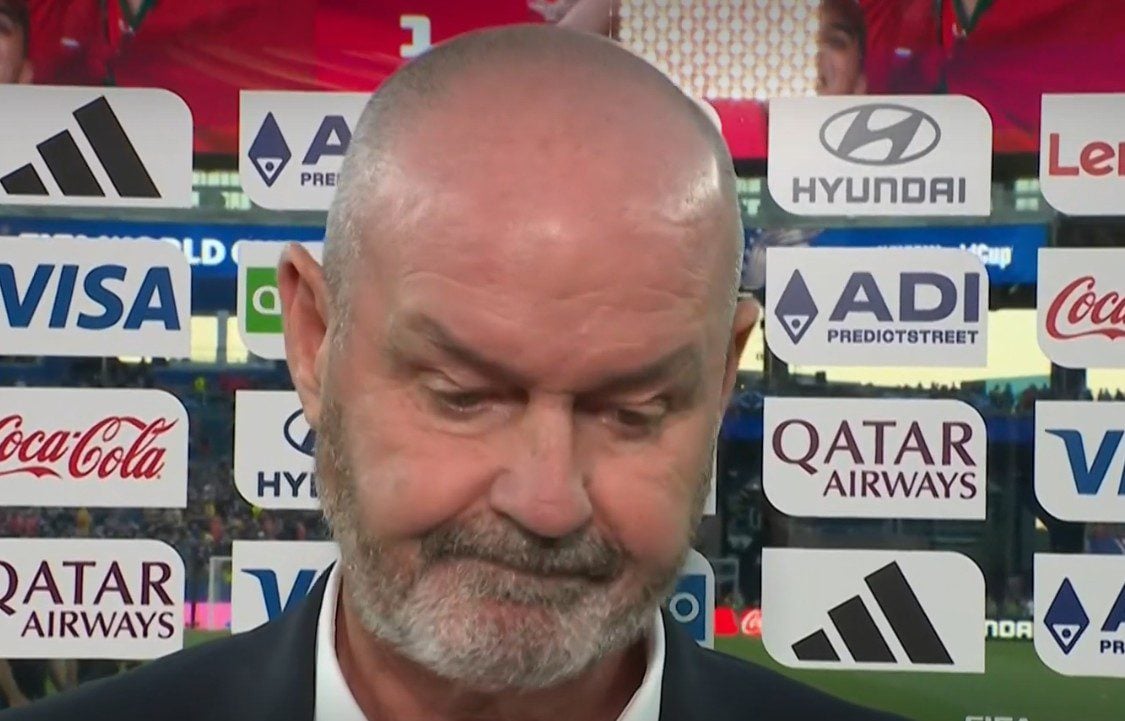
With the defeat effectively ending Scotland’s hopes, Steve Clarke broke his silence by posting an emotional message to supporters on social media. The manager accepted responsibility for the disappointing campaign while thanking fans for their extraordinary support throughout the tournament.
His statement read:
“To the Tartan Army: I know this campaign has fallen short of your hopes and ours. We fought, but we did not deliver the results you deserved. For every mile you traveled, every song you sang, and every flag you waved, I am deeply grateful. I share your pain, and I promise we will learn, rebuild, and rise again. Scotland’s story is not over. Alba gu bràth.”
The message quickly spread across social media, generating thousands of reactions from supporters around the world. Many praised Clarke for addressing fans directly and taking responsibility for the disappointing outcome, while others questioned whether the national team required fresh ideas ahead of future tournaments.
The reaction among Scotland supporters reflected a mixture of pride, frustration, sadness, and hope. Many acknowledged that qualifying for the World Cup itself represented significant progress after decades of disappointment, yet they also believed the squad possessed enough talent to progress beyond the group stage.
Supporters pointed to Scotland’s inability to convert promising attacking moments into goals, particularly against Morocco, where several opportunities went begging. Others highlighted defensive lapses against Brazil, arguing that individual mistakes proved costly against world-class opposition.
Questions have inevitably emerged regarding Clarke’s tactical approach. While many continue to credit him for transforming Scotland into regular tournament qualifiers, critics argue the team remains too cautious against stronger opponents and struggles to adapt when chasing matches.
Nevertheless, numerous former players and football analysts have defended Clarke, emphasizing the significant progress achieved during his tenure. Under his leadership, Scotland ended years of major tournament absence, rebuilt national confidence, and established a competitive identity that had been missing for much of the previous generation.
Mathematically, Scotland’s World Cup journey has not yet been officially concluded. Depending on results elsewhere, there remains an outside possibility that three points could prove enough to secure qualification as one of the tournament’s best third-placed teams. However, with an inferior goal difference and several competing nations still in contention, the odds remain firmly against them.
Should those results fail to materialize, Scotland will once again leave the World Cup after the group stage, extending a painful historical pattern that has frustrated generations of players and supporters alike.
Yet despite the disappointment, there are reasons for cautious optimism. Scotland’s qualification campaign demonstrated the nation’s growing competitiveness on the international stage, while the experience gained against opponents such as Morocco and Brazil could prove invaluable for the squad’s younger players moving forward.
The unwavering support of the Tartan Army throughout the tournament also served as a reminder that Scotland’s football identity extends far beyond results. Their loyalty, passion, and belief remained constant from the opening victory against Haiti to the final whistle against Brazil, embodying the resilience that has long defined Scottish football.
Whether this campaign ultimately ends in a miraculous qualification or a heartbreaking elimination, Scotland’s return to the World Cup has reignited belief that the national team belongs among football’s elite competitions. The immediate pain of defeat will linger, but the foundations built over recent years offer hope that this will not be another 28-year wait before the next appearance on the world’s biggest stage.
For Steve Clarke and his players, the challenge now is to transform heartbreak into motivation. For the Tartan Army, belief remains unshaken. And for Scotland, the dream of finally making a deep run at a World Cup has been delayed—but not abandoned.