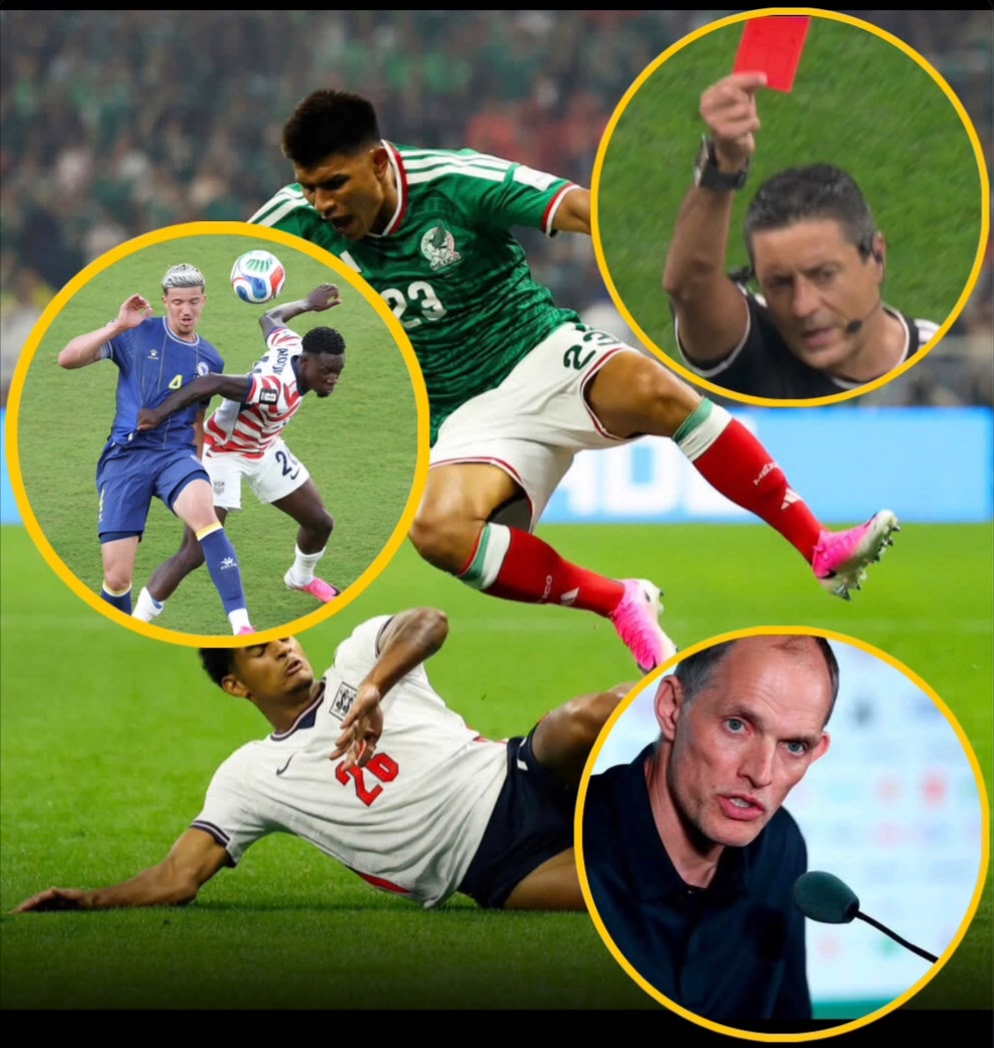
TUCHEL QUESTIONS FIFA’S DISCIPLINARY STANDARDS AFTER QUANSAH RED CARD : ENGLAND BOSS HIGHLIGHTS DOUBLE STANDARDS IN BALOGUN CASE

Tuchel Challenges FIFA’s Disciplinary Integrity After Quansah Red Card: England Manager Warns of Double Standards
Introduction
England manager Thomas Tuchel has raised serious concerns about FIFA’s disciplinary framework following Jarell Quansah’s controversial dismissal in England’s World Cup Round of 16 victory over Mexico. While Tuchel maintained that Quansah’s tackle did not merit a red card, his remarks went beyond defending his player. He questioned the consistency of FIFA’s disciplinary decisions, drawing sharp comparisons to the case of USA striker Folarin Balogun, whose suspension was unexpectedly lifted earlier in the tournament.
Tuchel’s comments have sparked debate across the footballing world, with fans, pundits, and officials weighing in on whether FIFA’s processes are being applied fairly — or whether external pressures are influencing outcomes.
The Quansah Incident
England’s 3–2 win over Mexico was overshadowed by Quansah’s dismissal in the 68th minute. The Liverpool defender slid into a challenge on Jesús Gallardo, winning the ball but catching the Mexican full-back with his trailing leg.
Referee Daniele Orsato initially allowed play to continue, but VAR intervened. After reviewing the footage, Orsato produced a straight red card. The decision left England to finish the match with ten men, sparking immediate protests from Tuchel and his staff.
Tuchel later told reporters: “We cannot call every strong challenge a red card. Football is a contact sport. Jarell won the ball cleanly. For me, this is not a red card.”
Tuchel’s Broader Critique
Tuchel’s frustration was not limited to Quansah’s dismissal. He used the incident to highlight what he sees as systemic flaws in FIFA’s disciplinary system:
– VAR Dependence: Tuchel argued that referees are being undermined by constant VAR reviews, leading to overly technical interpretations of challenges.
– Appeals Process: He warned that disciplinary appeals risk turning football into a “courtroom drama,” where outcomes depend less on the laws of the game and more on procedural loopholes.
– Credibility at Stake: Tuchel suggested that FIFA’s credibility is eroding if decisions appear inconsistent or influenced by external factors.
His remarks carried a tone of exasperation: “If one player’s ban can be lifted because of who makes a phone call, then the system is broken. We need consistency, not politics.”
The Balogun Comparison
Tuchel’s reference to “phone calls” was a pointed nod to the case of USA striker Folarin Balogun.
Balogun had been sent off in a group-stage match against Bosnia-Herzegovina. Under normal circumstances, he would have served a one-match suspension. However, FIFA suspended his ban under Article 27 of its disciplinary code, citing “exceptional circumstances.”
Reports suggested that US President Donald Trump personally contacted FIFA President Gianni Infantino to request a review. Balogun was subsequently cleared to play against Belgium, a decision that infuriated Belgian officials and raised eyebrows across the footballing world.
Tuchel’s sarcastic quip — “Perhaps Harry Kane should call the White House if we want fairness” — underscored his belief that political influence had crept into football’s disciplinary process.
England’s Defensive Dilemma
Quansah’s suspension leaves England short-handed in defense ahead of their quarter-final against Norway in Miami.
– Reece James is struggling with fitness issues.
– Djed Spence may be drafted in as a replacement.
– Tuchel could opt for a tactical reshuffle, moving Kyle Walker into central defense.
The Football Association is considering an appeal, citing the Balogun case as precedent. However, Tuchel expressed skepticism: “If FIFA sets a precedent, they must apply it consistently. Otherwise, appeals become meaningless.”
Fan and Media Reaction
The incident has sparked heated debate across the footballing landscape:
– Supporters: Many England fans believe Quansah’s dismissal was harsh, arguing that he clearly won the ball. Social media campaigns like #JusticeForQuansah gained traction.
– Pundits: Gary Neville described the decision as “ridiculous,” while Rio Ferdinand called it “a disgrace.”
– International Media: Mexican outlets defended the red card, insisting Gallardo was endangered. American media highlighted Tuchel’s comparison to Balogun, framing it as evidence of FIFA’s double standards.
The Larger Debate: VAR and Discipline
Tuchel’s comments have reignited the broader debate about VAR and disciplinary consistency:
– VAR’s Role: Critics argue that VAR has shifted the game toward hyper-technical interpretations, often ignoring context and intent.
– Refereeing Authority: Constant intervention undermines referees, leaving them hesitant to make decisions without technological backup.
– Political Influence: The Balogun case has raised fears that disciplinary outcomes can be swayed by external pressure, eroding trust in FIFA.
UEFA officials have already criticized FIFA’s handling of Balogun’s case, saying it “crossed a red line” and threatened the integrity of the competition.
Historical Parallels
Quansah’s red card adds to England’s troubled history with dismissals at major tournaments:
– David Beckham against Argentina in 1998.
– Wayne Rooney against Portugal in 2006.
– Raheem Sterling in a Nations League match in 2019.
Each incident sparked national debate, but Tuchel’s comparison to Balogun introduces a new dimension: the possibility that disciplinary decisions are not only inconsistent but politically influenced.
Conclusion
Thomas Tuchel’s insistence that Jarell Quansah’s tackle did not merit a red card has become more than a defense of one player. It has exposed deeper concerns about FIFA’s disciplinary process, VAR’s role in modern football, and the specter of political influence in sporting decisions.
By invoking the Balogun case, Tuchel has highlighted the need for transparency and consistency. For England, the immediate concern is whether Quansah’s suspension will stand — a decision that could shape their quarter-final against Norway. For FIFA, the challenge is greater: restoring trust in a system that increasingly appears vulnerable to external pressures.
As Tuchel concluded, “Football must be fair. If it is not fair, then it is not football.”