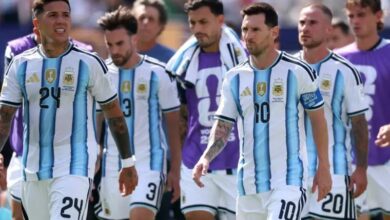
🚨 LIONEL MESSI LABELLED ‘CHEAT’ AND ‘DISGRACE’ FOR ARGENTINA INCIDENT IN WORLD CUP FINAL VS SPAIN

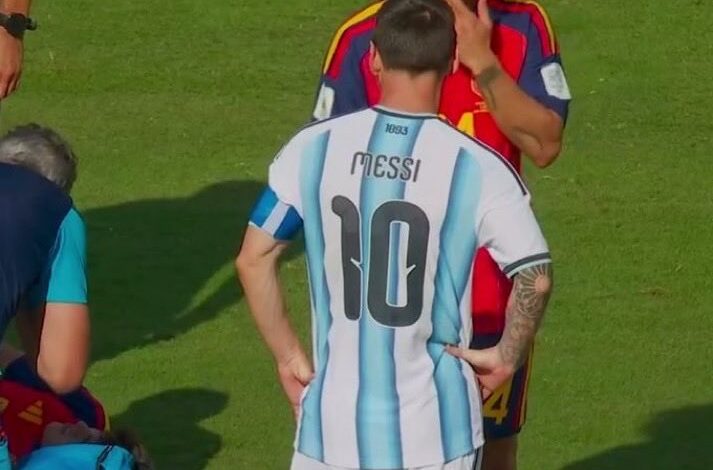
Lionel Messi has found himself at the centre of a fresh storm following Argentina’s dramatic World Cup final defeat to Spain, with critics accusing the legendary forward of attempting to exploit a controversial new tournament rule during the closing stages of the match.
Argentina’s hopes of defending their World Cup crown ended in heartbreaking fashion as Spain secured a 1–0 victory after extra time, with Ferran Torres scoring the decisive goal. But while Spain celebrated their second World Cup triumph, attention quickly turned towards an incident involving Messi and Spain defender Marc Cucurella that has sparked heated debate among football fans and pundits.
The controversy occurred after Argentina midfielder Enzo Fernández was sent off during the second half of extra time. Fernández received a second yellow card following a reckless challenge on Pau Cubarsí, leaving Argentina with only ten players as they attempted to survive Spain’s relentless pressure.
Moments later, Messi appeared to appeal to the referee over an incident involving Cucurella. The Spanish defender had reportedly covered his mouth while speaking, and Messi appeared to suggest that the action should be investigated under a new World Cup regulation concerning players covering their mouths during confrontational exchanges.
The referee, however, did not take further action.
That decision immediately created debate.
Critics accused Messi of trying to use the new rule to get an opponent into trouble at a crucial moment of the final. Some pundits described the behaviour as desperate and unsporting, while others argued that Messi was simply making an appeal to the referee and that there was nothing wrong with asking officials to examine a potential breach of the rules.
The incident has therefore divided football supporters.
For Messi’s critics, the moment represents another example of the intense gamesmanship that has sometimes surrounded Argentina during the tournament. For his supporters, however, it was simply a captain attempting to protect his team and make sure the rules were applied correctly.
Whatever the interpretation, the incident has become one of the most discussed moments from a final that was already filled with drama.
The controversy is particularly significant because of Messi’s status in football.
At 39 years old, the Argentina captain was playing in what was expected to be his final World Cup match. He had already created history by reaching his third World Cup final, an achievement accomplished by only a handful of players in the history of the competition.
Messi entered the final as one of the most decorated and influential players in World Cup history. He had also been one of Argentina’s most important players throughout the tournament, contributing goals and assists as the defending champions progressed through the competition.
His influence was particularly visible in Argentina’s semi-final victory over England, when he played a major role in the comeback that secured their place in the final.
Against Spain, however, the story was very different.
Spain dominated possession and controlled much of the match, limiting Argentina’s opportunities to create clear chances. The Spanish side’s disciplined defensive structure made it extremely difficult for Messi to influence the game in the same way he had done during earlier rounds.
Argentina goalkeeper Emiliano Martínez produced a remarkable performance, making numerous saves to keep his team alive.
But eventually, Spain’s pressure became too much.
Ferran Torres found the decisive goal in extra time, sending Spanish supporters into celebration and ending Argentina’s hopes of becoming only the third nation to win consecutive World Cup titles.
For Messi, it was a painful ending.
The player who had finally achieved World Cup glory in 2022 had been given another opportunity to lift the trophy. Instead, he watched Spain celebrate as Argentina’s title defence came to an end.
The controversy surrounding the Cucurella incident has therefore added another layer to an already emotional final.
Some critics have gone as far as calling Messi a “cheat” and a “disgrace” over the incident.
However, those descriptions are opinions rather than established facts, and the incident itself remains open to interpretation.
There is no indication that Messi was punished for the appeal, and the referee did not consider the situation serious enough to take action against Cucurella.
That has not stopped the debate from spreading across social media.
Football fans have become increasingly divided over the use of new rules during the tournament. The regulation concerning players covering their mouths was introduced to address situations where players may use the gesture to conceal potentially abusive or inappropriate language.
The rule has already attracted attention during the tournament, with other incidents involving players being scrutinised.
The controversy surrounding Messi therefore comes at a time when players and officials are still adapting to the new regulations.
The question is whether Messi genuinely believed Cucurella had violated the rule or whether he was simply attempting to put pressure on the referee.
That is where opinions differ.
Supporters of Argentina argue that every captain has the right to appeal to the referee. Footballers regularly complain about challenges, handballs, time-wasting and potential disciplinary offences. From that perspective, Messi’s actions were no different from what happens in almost every major football match.
His critics, however, believe the incident was unnecessary and that Messi should have focused entirely on helping Argentina recover from the loss of Fernández.
The timing certainly made the incident more controversial.
Argentina were already down to ten players, and Spain were pushing for the winning goal. Every second was crucial. Any potential disciplinary action against a Spanish player could have changed the balance of the match.
Ultimately, nothing came of the appeal.
Cucurella remained on the pitch.
Spain continued to attack.
And eventually, Torres scored the goal that decided the World Cup.
The defeat also marked the end of an extraordinary era for Messi and Argentina.
The 2022 World Cup triumph had finally delivered the trophy that had escaped Messi for so long. After years of criticism and comparisons with other football legends, Messi finally lifted the biggest prize in international football.
Four years later, he returned to lead Argentina once again.
The journey to the final demonstrated that his influence had not disappeared with age. Even at 39, Messi remained capable of producing moments of extraordinary quality and contributing at the highest level of international football.
But Spain proved to be the stronger team when it mattered most.
- Their victory was built on possession, patience and tactical discipline. They controlled 65.1 percent of the ball and recorded 20 shots compared with Argentina’s two, according to match reporting. Argentina’s defensive effort, led by Martínez, kept the game scoreless for long periods, but Spain eventually found the breakthrough.
The final also ended with further disciplinary controversy.
Fernández was dismissed during extra time, while Argentina’s Leandro Paredes was also shown a red card after the final whistle. The match therefore ended with Argentina down to nine players, highlighting the frustration that had developed as Spain took control.
For Spain, the victory marked their second World Cup title, 16 years after their historic triumph in South Africa in 2010.
For Argentina, it was a painful conclusion to their reign as world champions.
And for Messi, it was almost certainly the final World Cup chapter of one of the greatest careers football has ever witnessed.
The controversy involving Cucurella will probably continue to be discussed for some time. Some supporters will continue to argue that Messi was attempting to manipulate the officials, while others will insist that the criticism has been exaggerated because of the player’s enormous profile.
There is also an argument that the incident should not overshadow Messi’s achievements.
After all, the Argentine captain has spent nearly two decades at the highest level of football. He has won almost every major individual and team honour available to him, including the World Cup.
His final World Cup appearance may not have ended with another trophy, but his legacy in the competition remains extraordinary.
He reached three World Cup finals.
He became one of the tournament’s most prolific scorers.
He set records for appearances.
And, most importantly, he finally lifted the trophy that had defined so much of his international career.
The debate surrounding the Cucurella incident will ultimately become another small part of a much larger story.
For now, Spain are celebrating.
Argentina are reflecting on what went wrong.
And Messi faces the reality that his World Cup journey has finally come to an end.
Whether fans believe his actions were clever gamesmanship or unacceptable behaviour, one thing is certain: the incident has given football supporters another reason to debate one of the most polarising figures in the history of the sport.
The final whistle may have ended Argentina’s World Cup defence, but the arguments surrounding Lionel Messi are clearly not finished.
As Spain lift the trophy and begin their celebrations as world champions, Messi’s legacy will continue to dominate football discussions.
And perhaps that is the reality of being one of the greatest players the game has ever seen.
Every action is analysed.
Every decision is debated.
Every controversy becomes global news.
This time, a brief incident involving a new World Cup rule has placed Messi under the spotlight once again.
The question now is whether fans will remember it as a moment of gamesmanship, desperation or simply an ordinary appeal that became controversial because of the man at the centre of it.
Whatever the answer, the 2026 World Cup final has provided yet another unforgettable chapter in the remarkable story of Lionel Messi.
And while Spain walk away with the trophy, Messi leaves the World Cup stage with a legacy that is already secure.
The debate may continue.
The criticism may continue.
But the history will remain.