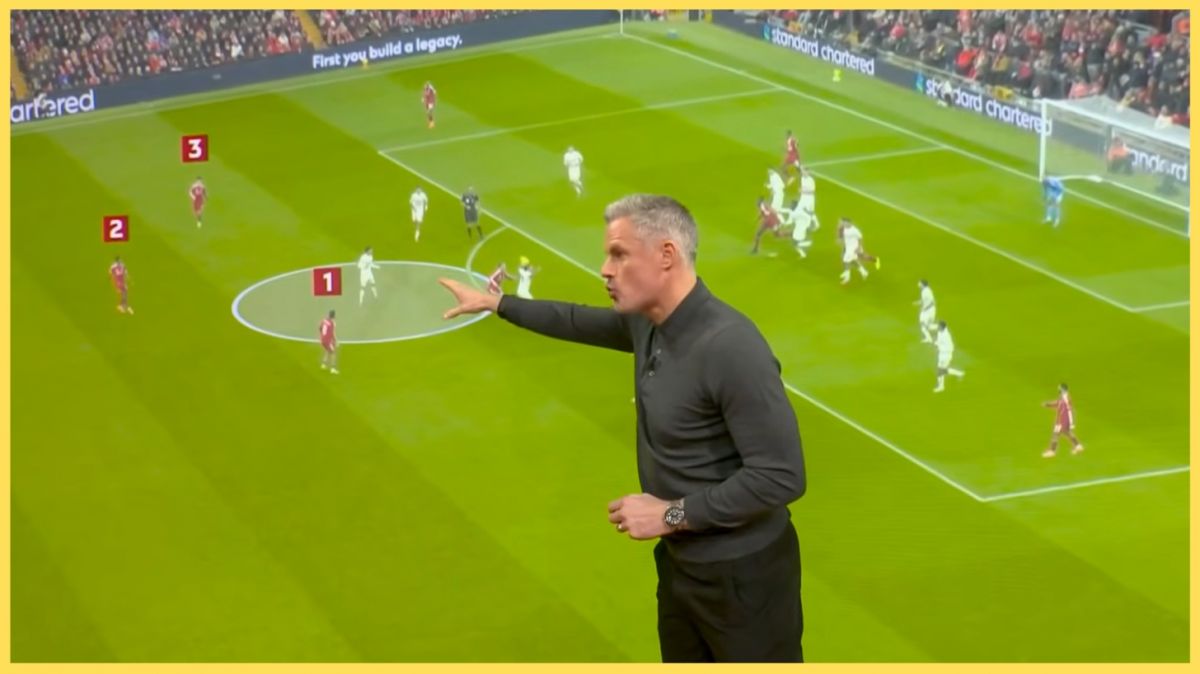
Jamie Carragher went viral for brutal analysis of Thomas Tuchel’s England tactics despite 2:0 win vs Panama

Jamie Carragher went viral for brutal analysis of Thomas Tuchel’s England tactics despite 2:0 win vs Panama.
England’s 2-0 win over Panama at the 2026 World Cup looked straightforward on paper. The result secured top spot in Group L and ensured safe passage into the newly expanded Round of 32. Yet beneath the surface, the match exposed tactical cracks that have left the nation divided. For many fans, it was another uninspiring display, echoing the lifeless 0-0 draw against Ghana. For pundit Jamie Carragher, it was the breaking point. His viral post-match rant tore into Thomas Tuchel’s system, sparking fierce debate across the footballing landscape.
The Mirage of a Comfortable Scoreline
At first glance, England did everything required: they won, kept a clean sheet, and advanced as group leaders. But the manner of victory was far from convincing. The two goals came not from fluid team play but from moments of individual brilliance. Jude Bellingham produced a dazzling solo run and strike for the opener, while Harry Kane capitalized on a chaotic scramble in the box for the second. Outside of these flashes, England’s attack looked sterile. They monopolized possession—over 70%—but spent most of the evening recycling the ball sideways and backwards against Panama’s compact defensive block. The lack of penetration and imagination was glaring, and it was this stagnation that fueled Carragher’s explosive critique.
Carragher’s Viral Breakdown
Within minutes of the final whistle, Carragher’s video analysis spread like wildfire online, amassing millions of views. Standing before a tactical board, he acknowledged the victory but warned fans not to be deceived by the scoreline. His words were blunt: “If you think that was a good performance, you are lying to yourselves.” He accused Tuchel of turning a squad brimming with attacking talent into a cautious, plodding machine. His analysis focused on three main flaws: the slow build-up, the omission of Cole Palmer, and the misuse of England’s wingers.
1. The Death of Verticality
Carragher highlighted England’s pass map, which revealed a heavy concentration of passes in midfield and defense, with little penetration into the final third. He argued that the center-backs and holding midfielders were too ponderous, often taking three or four touches before releasing the ball. This sluggish tempo allowed Panama’s defenders ample time to reset their shape. “International football is slow, yes, but this is agonizing,” Carragher fumed. “Panama’s defenders could read a book and still get back into position.” The absence of vertical runs or daring passes through the lines left England predictable and easy to contain.
2. The Cole Palmer Controversy
Carragher reserved his sharpest criticism for Tuchel’s decision to exclude Chelsea star Cole Palmer from the squad. Against deep defensive blocks, Carragher argued, England needed a creative “lock-picker”—a player capable of threading passes in tight spaces. Palmer, who had been one of the Premier League’s most inventive playmakers, was left at home. Carragher called it a “criminal tactical blunder,” insisting that Tuchel had sacrificed imagination for rigid discipline. “The most creative footballer in the country is sitting on a beach,” Carragher thundered. “That decision will haunt us when we face elite opposition.”
3. Isolated Wingers and Predictable Width
Carragher also dissected England’s ineffective use of the flanks. The wingers were instructed to stay wide, hugging the touchlines. But because the midfield build-up was so slow, by the time the ball reached them, Panama had already created defensive overloads. Full-backs rarely made underlapping runs, and wingers were discouraged from drifting into central pockets. This left Bellingham isolated as the lone creative force in midfield. The result was a predictable, one-dimensional attack that Panama handled with ease.
Tuchel’s Defiant Response
Tuchel, however, was unmoved by the criticism. In his post-match press conference, he defended his pragmatic approach. “In tournament football, you do not get points for style. You get points for winning,” he declared. He praised his players for controlling the game and preventing Panama from creating chances. For Tuchel, defensive stability and risk minimization are paramount. He argued that breaking down a compact low block is never easy, and credited Kane and Bellingham for stepping up when needed. “If people want fantasy football, they can play video games,” he quipped. His philosophy is clear: prioritize clean sheets, rely on world-class individuals, and grind out results.
The Numbers Tell the Story
Carragher’s critique was not just emotional—it was backed by data. Comparing the matches against Ghana and Panama reveals a troubling pattern of sterile dominance:
Metric vs. Ghana (0-0) vs. Panama (2-0)
Possession 74% 71%
Total Passes 785 712
Passes Backwards/Sideways 82% 79%
Shots on Target 1 3
Expected Goals (xG) 0.42 0.88
The statistics show that England’s possession was largely meaningless. Their xG against Panama was just 0.88—an alarmingly low figure against a modest opponent. The goals came from difficult, individual efforts rather than well-constructed chances. This supports Carragher’s claim that Tuchel’s system is failing to generate quality opportunities.
The Road Ahead: Knockout Crucible
With the group stage complete, England now faces the unforgiving knockout rounds. Mistakes against defensive minnows can be survived, but against stronger opponents, they will be punished. Carragher warned that if Tuchel persists with his cautious approach, aggressive teams will press England’s defenders and suffocate supply lines to Kane. In a single-elimination format, one stagnant performance could mean an early exit. His viral rant was not mere punditry—it was a warning siren to a manager who may be sleepwalking into disaster.
The Clash of Philosophies
The debate encapsulates a broader tension in English football: pragmatism versus flair. Tuchel’s track record shows that his risk-averse style can deliver trophies. But England’s fans and media demand more than results—they crave attacking excitement. Carragher’s fury reflects this cultural expectation. For him, Tuchel’s England is wasting its attacking riches. For Tuchel, the criticism is noise—he believes his job is to win, not entertain. The coming knockout matches will determine which philosophy prevails.
Conclusion
England’s 2-0 victory over Panama may have secured progression, but it has ignited a storm of debate. Carragher’s viral rant exposed tactical flaws that statistics corroborate: slow build-up, lack of creativity, and predictable width. Tuchel remains defiant, insisting that results matter more than style. As England enters the Round of 32, the stakes rise dramatically. The clash between Tuchel’s pragmatism and Carragher’s demand for flair is more than a pundit-manager spat—it is a battle over the soul of English football. Whether Tuchel adapts or doubles down will shape England’s fate in the tournament.